
Finding Identity through Anime: The Solace, Sonority, and Soul of Cowboy Bebop
Kieran Casey
MM Student, Music for New Media
The Peabody Institute at Johns Hopkins University
kcasey20@jh.edu
Dear Mom and Dad,
When I was a kid, I struggled with my hyphenated identity. As someone who is both Black and White, I often felt pressure to choose a side, even when I felt I didn’t belong to either. My peers would laugh at me for my excitement about the tuba music I was playing and claimed I wasn't “Black enough” because I didn't listen to rap. I was bullied not only at school and in my extracurriculars, but even in places where I should have felt safe, at home and in church. I felt as though I was being rejected by my own people, which distanced me further from Black culture. Everywhere I found myself, I felt like I didn’t belong, except in the world of anime.
Anime became a home for me. I felt accepted through the many different characters, relating to parts of their lives that mirrored my own. Anime took me to another world where I could imagine how I would deal with their problems. I would learn, feel, and experience a sense of tranquility, which I still haven’t found in anything else. Within the vibrant, imaginative landscapes and complex narratives of anime, I discovered a sense of belonging that had eluded me in the real world. It was an intense connection, a recognition of shared humanity despite the fantastical settings. Of all the anime I’ve ever watched, Cowboy Bebop is the one that constantly provided me with these feelings.
Introduction
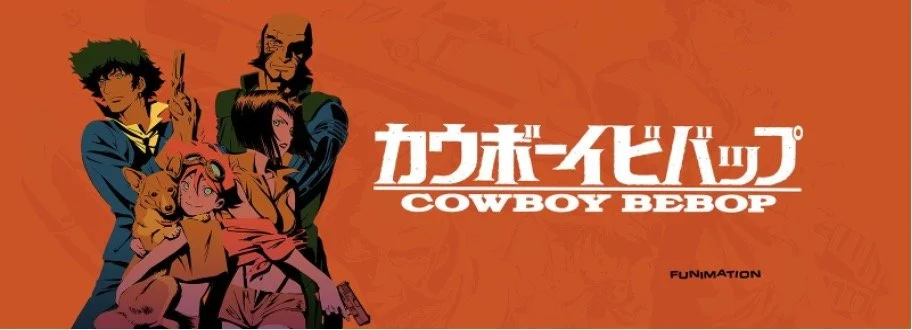
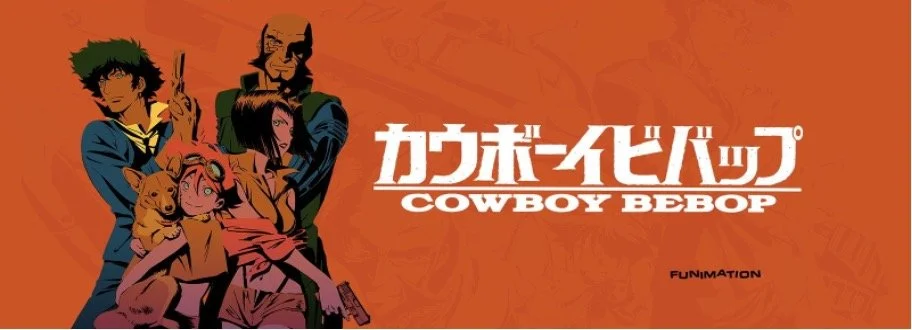
Figure 1: This graphic, used to promote Cowboy Bebop on the North American Funimation distribution service in 1998, comprises the main characters of Cowboy Bebop: Spike (top left), Jet (top right), Faye (bottom left), Ed and Ein (bottom right).
The jazz-infused score of Cowboy Bebop, by Yōko Kanno’s set a sonic atmosphere to director Shinichirō Watanabe's vision of a dystopian galaxy brimming with adventure, nostalgia, and escapism. In his manifesto for the show, Watanabe suggested that this anime was about jazz. “In New York City in 1941… young jazz men with a new sense are gathering… They must create new dreams and films by breaking traditional styles. The work, which becomes a new genre itself, will be called… COWBOY BEBOP” (Watanabe, cited in Keene 2021, 44).
I first watched Cowboy Bebop in 2020. In recent years I’ve revisited the series, and after a close rewatching as well as further exploration of Watanabe’s goals for the soundscape, I began to realize why I felt such a connection to it. This essay explores my reflection on how the Cowboy Bebop soundtrack shaped my identity as a young Black man, given my deep connection to the story, music, and Watanabe's sonic vision. I argue Yoko Kanno created a score that embodies soul, by which I mean the soundtrack channels an emotional depth rooted in Black musical traditions where the transformation of sound becomes a vessel for human feeling, identity, and resilience. Furthermore, Cowboy Bebop provides solace for those with hyphenated identities, reimagines the concept and spirit of bebop in jazz music, and broadly speaking Black culture, and resonates deeply with the shared experience of the current young generation of African Americans through Afrofuturistic aesthetics.
The Bebop Music in Cowboy Bebop
Kanno admitted she was skeptical about writing a jazz soundtrack for Cowboy Bebop, as she was worried it wouldn’t sell (Kanno, 2020). She was wrong. Premiering in 1998 in Japan and 2001 in the U.S., the show became an anime classic, with its score marked by the anime community as a central part of its success. Kanno began writing before Cowboy Bebop was fully animated, and her music inspired scenes and characters. Watanabe built the show around concepts that are central to Black genres like bebop: improvisation and collaboration. Rejecting conventional linear storytelling techniques from the 1990s, Watanabe decided to make the narrative of Cowboy Bebop episodic: he aimed to mimic the spontaneity of a jazz jam session.[1]
Cowboy Bebop blends film noir, western, and sci-fi themes. The story is set in the year 2071, following bounty hunters, or “cowboys,” chasing criminals across a lawless galaxy. Throughout the episodic narratives, the audience experiences a diverse array of settings within the galaxy, new also to the characters in the show. Andrea Keene (2021, 50) argues that Cowboy Bebop is a depiction of “Japanese changing cultural identity.” She further describes how the series represents a “challenge to the longstanding idea of homogenous Japanese identity, (Keene 2021, 54).” In Cowboy Bebop, Bebop, as a form and style of jazz characterized by the juxtaposition of sometimes wildly different sounds, perfectly scores the society imagined by Watanabe. Although Watanabe does not explicitly refer to Afrofuturism as an influence for the show, this anime oozes Afrofuturism, a Black ideal broadly defined as “African American voices” with “other stories to tell about culture, technology, and things to come using sci-fi imagery, futurist themes, and technological innovation in the African diaspora” (Dery 1994). Cowboy Bebop weaves a Japanese reimagination of bebop jazz with diverse futurism, showing an intercultural and Afrofuturist visual dialogue through the sounds of Blackness (Black sounds) and Japanese storytelling.
A Parallel Connection: Japanese and Black Reimaginations
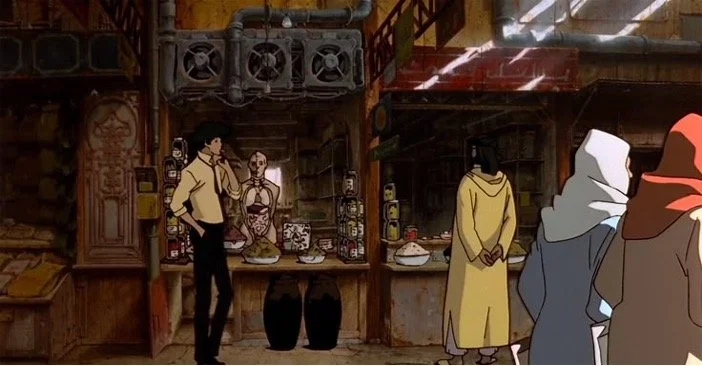
Figure 2: On Mars, Spike Spiegel, the main character of Cowboy Bebop, searches for intel on a criminal with a bounty.
When I refer to Blackness in music, I mean the African American musical lineage. The history of Black music encompasses a vast and intricate tapestry of genres, styles, and cultural practices that respond to the lived realities of African Americans. Certain sonic markers signify this lineage, markers tied to Negro spirituals, blues, and jazz. W.E.B. Du Bois, in The Souls of Black Folk, called the music of Negro religion “the most original and beautiful expression of human life and longing yet born on American soil” (Du Bois 2015 [1903], 189). Many conversations that discuss hearing race within music cite Du Bois, and Jennifer Lynn Stover, who also draws on Du Bois, extends these insights into her concepts of “the sonic color line” (20) and “the listening ear” (24), offering another lens for understanding Black music. Sound, she argues, is always racialized: certain bodies are expected to produce or desire certain sounds, shaped by white listening practices (Stover 2016).
Musicologist Matthew Morrison (2020) calls this legacy “Blacksound,” describing how the history and trends of American popular music are inextricably linked to the damaging origins of Blackface minstrelsy. Given minstrelsy’s profound effect on American music, Black musical traditions developed in the decades since have responded to, and pushed back on, white listeners’ assumptions about Blackness evident in minstrel music. Bebop, which pushed back against the commercial simplification of the earlier genre of swing, and Afrofuturism, which imagines new, liberated Black futures through science fiction, technology, and sound, are two key concepts in understanding the ongoing artistic evolution of African American musical expression in the twentieth century.
Born in the 1940s through musicians like Charlie Parker, Thelonious Monk, and Dizzy Gillespie, bebop rejected the white mainstreaming of swing, which was often performed by white musicians imitating “Blacksound,” attempting to incorporate elements of New Orleans ragtime or Texas blues. Jazz studies scholar Scott DeVeaux (1997), in The Birth of Bebop: A Social and Musical History, references African American writer Amiri Baraka when contextualizing bebop as a revolution: “The thrust of the bop revolution, according to Baraka, was directed not just against white America, but also against those blacks who had yielded their birthright of cultural autonomy in pursuit of the fraudulent goal of assimilation” (DeVeaux 1997, 23). The revolutionary nature of bebop is reflected clearly in its musical characteristics: it is virtuosic, sophisticated, vulnerable, and rooted in autonomous individualism.
Japanese jazz is also heavily influenced by bebop, which became popular during an important moment in Japanese musical history. Ethnomusicologist Taylor Atkins (2001, 251) writes that “one of the distinguishing traits of the postwar Japanese jazz community, in contrast to the social mainstream, was that the conventional racial hierarchy was inverted: the emerging consensus at the height of the ‘funky boom’ favored Black musicians as inherently bluesy and funky and thus superior players.” This moment represented a shift from the earlier history of jazz in Japan, which had roots in 1920s–30s dance orchestras and swing bands, influenced by artists such as Benny Goodman and Artie Shaw. Japan encountered the bebop revolution more fully in the 1960s–70s during an unprecedented “jazz boom.” Postwar youth flocked to concerts of what was called “modern jazz,” encompassing styles such as bebop, cool jazz, and other progressive approaches (Atkins 2001, 183). The intensely “anti-assimilationist sound” (Jones 1963, 181) of bebop likely appealed to Japanese youth because they heard within it freedom, soul, and musical reimagination.
The Japanese jazz boom paralleled the rise of Afrofuturism in the United States. Artists such as Sun Ra, George Clinton, and Lee “Scratch” Perry were constructing sonic worlds shaped by extraterrestriality, futurism, and visions of Black futures (Corbett 1994, 7). It is therefore not far-fetched to suggest that, amid Japan’s own jazz boom, Afrofuturist currents influenced how Japanese musicians, listeners, and later animators interpreted and reimagined Black musical expression. Afrofuturism provided this framework through which futurity, hybridity, and improvisation could be sonically and visually intertwined. This broader transnational exchange helps show why Cowboy Bebop feels both distinctly Japanese and unmistakably grounded in Black musical lineage.
The Soul of Cowboy Bebop
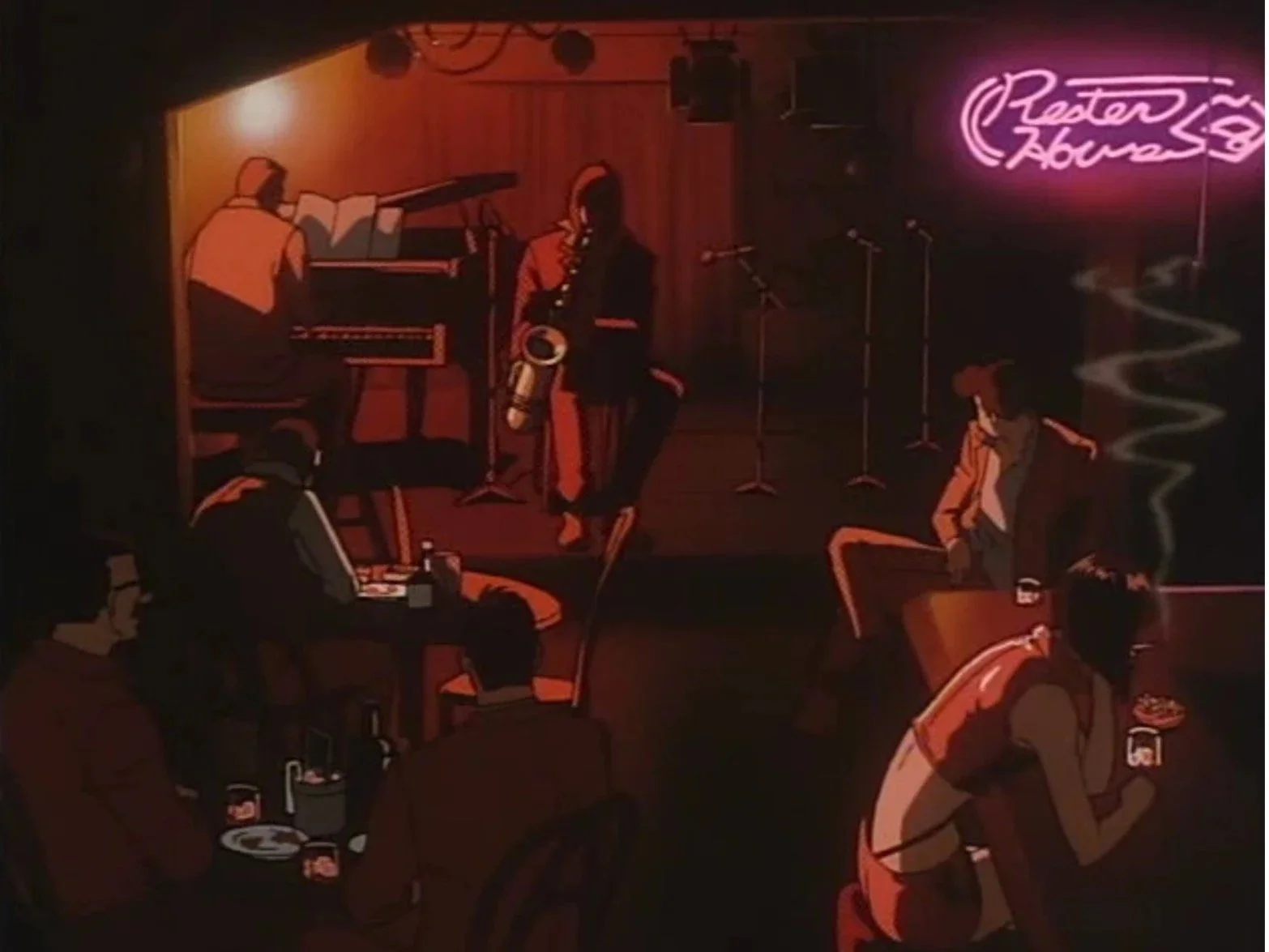
Figure 3: In an episode titled Jupiter Jazz 1, Faye (bottom left) enjoys a drink at a bar titled “Resters House”
Yoko Kanno believed jazz to be an art form of many shapes. In Rose Bridges “Cowboy Bebop Soundtrack” Kanno relays a memory of watching a jazz funeral in New Orleans, she found the music “expressed every aspect of life, including resignation, grief, and intimacy” (Kanno, quoted in Bridges 2017, 45). She alongside Watanabe were inspired by the genre, and she explains that she “chose to create such music believing that people’s emotions in their everyday life would be the same in the future, even in outer space,” (Kanno 2020). This view of human nature, struggle, and vulnerability is what I see and hear as soul. This soul is what I felt within the music of Cowboy Bebop, as I heard the sound of my people and their history through the horns of a Japanese band, the Seatbelts, and its composition by Yoko Kanno. This composition is what provided me solace and a journey in self-discovery.
The sound in the sessions of Cowboy Bebop taught me something about myself. Experiencing my culture in this setting, a futuristic dystopian society that was more diverse than anything, was exhilarating; It felt like me. In particular, I remember the episode “Jupiter Jazz part II,” in which its tragic climax was scored by a track titled “Space Lion” which consisted of synths, African percussion (Djembe and Bongos), and a soaring saxophone. The sound of this show is Black, while the visuals were bi/multi-racial, the experience of the anime was that of Japanese storytelling, and finally the problems were just human. This comfort came from perceiving an Afrofuturist, multicultural world that let me imagine a space where my Blackness wasn't confined by stereotypes and instead offered me a vision of freedom where I could exist unapologetically. From the very first episode, “Spokey Dokey” introduced the main characters, Spike Spiegel and Jet Black, with blues harmonica and resonator guitar. Although I knew this was an anime, I immediately saw two Black men[2] sharing a meal on a spaceship, and I was more intrigued than ever.
Spike Spiegel is a haunted ex-hitman drifting through space, chasing bounties while trying and failing to escape the ghosts of his past through his adventures on the Bebop. As I experienced Spike’s story, my perspective on life changed based on two quotes from his adventures: “You’re gonna carry that weight” and “Whatever happens, happens.” The first is a quiet truth that no matter what I’ve been through, the weight of my experiences stay with me, and make me who I am. The second helped me let go of what I can’t control, and start taking control of what I could. As a Black person in America, there is no room for error; I must be better than the white man just to be acknowledged. However, I have decided that I want to pave my own path and create a space for myself to exist along with others like me. These quotes, paired with Yoko Kanno’s soundtrack, allowed me to push through constant adversity and realize that I needed to learn to love who I am. I couldn’t run away from what haunted me forever: the trauma and unacceptance, the pain of not feeling like I’d ever belonged anywhere. I needed to take the step forward to acceptance like Spike did in his last moments before he waltzed toward his death.
An Identity Maker Influence in Cowboy Bebop
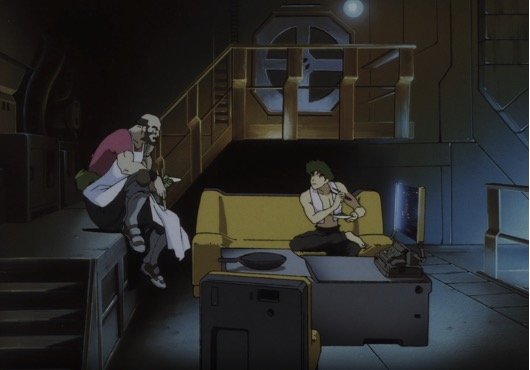
Figure 4: In the first episode, Asteroid Blues, Spike and Jet share a meal while talking about their next adventure.
I’m not alone in this experience of solace and identity creation. My friend and rugby teammate Hektor, who is Korean-British, also found himself in Cowboy Bebop. Like me, he was always “not enough” (Thompson, 2025) for one side of his heritage, but anime offered him a space where his identity was fluid. Watching Spike taught him to loosen the suffocating expectations from his family and sports coaches. The Bebop crew became a model for “found family” (Thompson, 2025), reminding him that belonging somewhere is chosen, not given. As a fan of this series, he also has an affinity for its soundtrack. Tracks like “Tank!” and “Rush” captured the show’s cool intensity, which also pulled him deeper into its world. When I was talking to him about his favorite scenes from the show, he pointed to the very first action scene within the entirety of Cowboy Bebop. We agreed that this opening fight scene, scored by “Rush,” is the perfect embodiment of the show with its horns blaring, percussion driving, and bullets flying; it was pure soul.
In the Black community, this anime is viewed as one of the greats. Airing on late-night Cartoon Network, it was a gateway into anime for many young Black viewers. Jordan Purnell Jackson, a Black-American artist, professor, and comic creator residing in the Baltimore area, recalls watching the anime when he was 16. Jackson was drawn to the intercultural nature of Cowboy Bebop and saw a lot of himself within the entirety of the series. He loved it so much that it affected his experience of watching anime as a whole. He stated that when he got to his twenties, he would recall trying to look for himself in other anime like Cowboy Bebop but took a hiatus from watching the newest shows because “he couldn’t find characters who looked like him, or none of the shows would reflect himself,” (Jackson, 2025). Regardless, Jackson describes this anime as a massive influence within his artistry. Cowboy Bebop itself provided a lot of solace; he even called it a “home” for him. It felt very safe and relatable to watch, always returning to view his Blu-ray copy. As an artist it “was a main influence of his identity as a creator,” (Jackson, 2025). This was an escapism but also a great identifier and representation of influences in his work. Cowboy Bebop, then, is not just entertainment. It is an identity-maker, shaping the way marginalized and hyphenated individuals see themselves and their possibilities.
Conclusion
Cowboy Bebop is deeply influenced by Black culture, from the score to its very name. Watanabe set out to create an anime unlike anything before it, and while he may not have anticipated how profoundly it would resonate with the culture that inspired it, he has touched the lives of many in the Black community. For me, this experience became a bridge to my own heritage and to another culture, all resulting in a journey of self-reflection and discovery. Through his collaboration with Yoko Kanno, the series placed Black musical lineage as a theme for a Japanese narrative, creating a work that established an intense transcultural dialogue.
“I’m not going there to die. I’m going to find out If I’m really alive”- Spike Spiegel.
In 2020, I came home with Spike Spiegel tattooed on my shoulder, with the quote: “See you, space cowboy… you’re gonna carry that weight.” For me, it wasn’t impulsive; it was a permanent marker of how Cowboy Bebop helped me accept who I am. The show speaks across cultures, but for those of us with hyphenated identities, it resonates on another level. Its soundtrack is inseparable from its story, embedding Black sounds into a Japanese anime, creating an Afrofuturist space where my true belonging felt possible. “Jazz meant talk[ing] about your troubles for which there's no solution,” (Kanno, quoted in Bridges 2017, 45). Yoko Kanno, a brilliant composer from Sendai, Japan, who knew nothing of the hardships of the African American experience, spoke so clearly about the music of our people, Mom. The director of the anime also made it a mission to include characters who look like us, stating “Lots of times when you watch anime, the characters have white skin — all the characters in fantasy stories all have white skin, which I never liked. I wanted to have lots of characters in Bebop without the white skin, and if people weren’t used to that, well, maybe it would even make them think a little bit about it, (Watanabe quoted by LeSean Thomas via Twitter)” Watanabe’s diverse vision and Kanno’s score together formed a sonic refuge, a philosophy, and a call to embrace myself. Cowboy Bebop mirrors the silhouette of jazz, an improvisatory, soulful, and free art form. For me, it is more than just an anime. It is solace, inspiration, and a representation of who I am. You both have done so much for me and I am forever grateful, but so has anime, and I hope you both learned a bit more about me through this essay.
Your loving son,
Kieran Casey
Notes
[1] Episodes in Cowboy Bebop are called sessions.
[2] There is much discourse online about what race Spike is. Spike Spiegel was born on Mars, in which the Cowboy Bebop movie shows us is a very diverse place, meaning he could be a mix of a lot of different ethnicities and backgrounds.
References
Atkins, E. Taylor. 2001. Blue Nippon: Authenticating Jazz in Japan. Duke University Press.
Baraka, Amiri. 1963. Blues People: Negro Music in White America. William Morrow and Company.
Bridges, Rose. 2017. Yōko Kanno's Cowboy Bebop Soundtrack. Bloomsbury Academic.
Burlingame, Russ. 2018. “‘Cowboy Bebop’ Director Opens Up About Anime’s Focus On Diversity.” ComicBook.com, May 23, 2018.
https://comicbook.com/anime/news/cowboy-bebop-director-opens-up-about-animes-focus-on-diversity/
Corbett, John. 1994. “Brothers From Another Planet, The Space Madness of Lee ‘Scratch’ Perry, Sun Ra, and George Clinton.” In Extended Play: Sounding Off from John Cage to Dr. Funkenstein, 7–24. Duke University Press.
Dery, Mark 1994. “Black to the Future: Interviews with Samuel R. Delaney, Greg Tatem and Tricia Rose,” In Flame Wars: The Discourse of Cyberculture, edited by Mark Dery, 179–222. Duke University Press,
DeVeaux, Scott Knowles. 1997. The Birth of Bebop: A Social and Musical History. University of California Press.
Du Bois, W. E. B. 2015 [1903]. The Souls of Black Folk. Yale University Press.
Jackson, Jordan. Conversation with author. May 8, 2025. Baltimore, MD, U.S.A.
Keene, Andrea C. 2021. "Anime as Socio-Cultural Critique in Shinichiro Watanabe’s Cowboy Bebop, Samurai Champloo, Terror in Resonance, and Kids on the Slope." PhD diss., Union Institute and University.
Morrison, Matthew D. 2020. “Blacksound.” In The Oxford Handbook of Western Music and Philosophy, edited by Tomás McAuley et al. Online edition. Oxford Academic. https://doi.org/10.1093/oxfordhb/9780199367313.001.0001
Stoever, Jennifer Lynn. 2016. The Sonic Color Line: Race and the Cultural Politics of Listening. New York University Press.
Thompson, Hektor. Conversation with author. May 2, 2025. Baltimore, MD, U.S.A.
Yalcinkaya, Günseli. 2020. "How Yoko Kanno Created the Cowboy Bebop Soundtrack." Dazed Digital. Published December 3, 2020. https://www.dazeddigital.com/music/article/51208/1/how-yoko-kanno-created-the-cowboy-bebop-soundtrack