
Sounding Out the S/M/Othering: Turning an Ethnomusicological Ear to Musicking amongst People with Profound Intellectual and Multiple Disabilities (PIMD)
Kate Adams
PhD researcher in Ethnomusicology and Learning Disabilities
SOAS, University of London
657393@soas.ac.uk
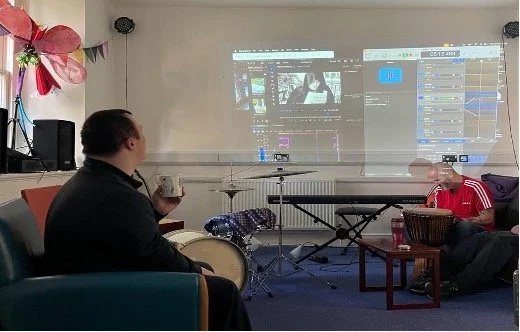
This piece contains short audiovisual accompanying vignettes, featuring two research collaborators, Herbie and Brandon. The links are accessed by clicking on the photos. Traditional consent for their use is obtained from parents/support staff, covering legal requirements, but we have endeavored to use imaginative methods to consider consent using alternative means of communication to verbal. We watch the videos with them, and with other people who know them well, to be as clear as to their feelings about the film. These films transcend the s/m/othering of the title, replacing acts of overprotection and silencing with reciprocal, co-produced representation.
INTRODUCTION
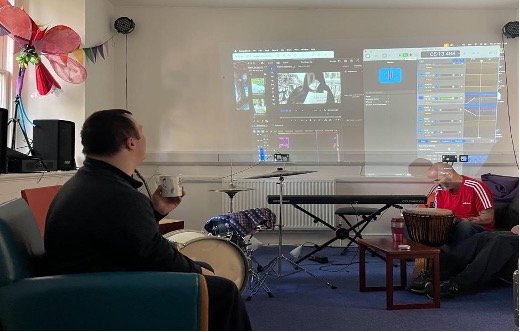
Figure 1: checking consent with Brandon
“Ahhh, bless!” is the response I often get when I say that I am musicking with people with learning disabilities, epitomizing the infantilization and s/m/othering that members of this group are subjected to, when care becomes inappropriate mothering and the overprotection of smothering. Christopher Small’s musicking is a powerful framework for shifting attention from musical works to the social relationships enacted through musical encounters (Small 1998). In my work, musicking functions as both method and ethos, structuring our encounters as co-creative acts, where meanings emerge through listening, gesture and response, ethically positioning these acts as explorations of how we could live – relational rehearsals for more inclusive social worlds.
Musical activity for people with intellectual disabilities often focuses on therapeutic and developmental potential, particularly as a conduit to language skills - a deficit-centric paradigm with music used to improve perceived shortfall from “normal” ability. Folks with PIMD[1] are smothered, mothered and othered, overprotected and underestimated in everyday life and in musicking. In this paper, with an ear to disability studies and ethnomusicological practice, my collaborators Herbie and Brandon demonstrate the power of non-verbal communication in music, and I see our work as an agent of change, not merely a way to cope with an inevitable reality. I aim to subvert society’s impression of those with PIMD from being passive recipients of musical support to active music makers, and to reimagine their non-normative participation as musical. To do this, I invoke the ethnomusicologist’s gaze which treats sound, music, gesture and embodied expression as valid forms of communication and meaning-making - an inclusive methodology in which sound and embodied gesture work together to establish sociality (Turino 2008).
Vignette 1 (Film): Herbie in His Own Words[2]
Herbie rarely looks at me, but in this session, I feel that he communicates clearly – I am sitting so close that I can feel his breath, which guides me to the time changes and subtleties of his musicality. His back and shoulders swell with his breath, and then he holds it, releases, and moves the music along. He carries me with him and guides our musicking.
Ethnomusicologist Michael Bakan compares his work in Balinese Gamelan to that he does with autistic children,[3] and notes that in the former he “did not look to identify impairments or deficits ... to propose any such form of remediation would have been ludicrous within the epistemological parameters of an ethnomusicological worldview” and questions why you would do so with the latter (Bakan 2014a). In this piece, Bakan proposes an ethnomusicology of autism, which I would like to expand to the world of PIMD – sounding out the s/m/othering. Following this, I do not consider that Herbie holds the ukulele incorrectly, or that he strums with the wrong hand, nor that his vocalizations are out of tune.
I work two days a week at OpenStoryTellers,[4] an arts-based day service for adults with learning disabilities. Brandon comes two days a week, but Herbie is not ready for the group sessions yet, so I see him one to one. As a creative facilitator, I design and run daily workshops as well as public shows - vignette 2 is from my first day working with them.
Vignette 2 (Film): First Day with Brandon[5]
I sit next to Brandon and begin to play “Puff the Magic Dragon” while the others in the room watch. He reaches for me, and I worry about my violin and move away. I feel the room react, so I move back. I think Brandon laughs at me – I feel judged, but accurately and kindly. When I first hand him the bow there is a collective gasp as he begins to play, but my hand is on his, holding tightly, guiding his movement and still my left hand determinedly plays “Puff.”
Research into music amongst folks with PIMD is often situated within therapeutic and medicalized contexts and in terms of healthcare and rehabilitation rather than artistic practice (Rushton et al. 2023). Herbie carries a collection of jar lids, which he taps, scrapes and rhythmically uses to beat and pulse (see vignette 3). This is medicalized as “stimming”[6] rather than considered as a musical impulse.
Vignette 3 (film) Herbie and Kate Song (2025)[7]
I am disappointed Herbie has put down his ukulele until I realize the focus he has on vocalizations. Maybe he can’t do both, I think at the time. It is only on listening back that I hear the percussive accompaniment he is providing with the lids, and the delight of his singing our names.
Alan Merriam contends that “music is a universal human behavior” and “a form of communication: it is human behavior in sound” (Merriam and Merriam 1964, 6–7; 209). Yet the prevailing notion of “universality” in the 1960s systematically excluded people with learning disabilities, even though music often becomes an essential communicative resource when speech is constrained or unavailable. Merriam’s work, shaped by a period in which people with learning disabilities were routinely cast in dehumanizing, even “sub-human,” terms, reproduces a narrow and normative framework that erases their musical agency. Later scholars, such as Gary Ansdell, have challenged this limited perspective by advancing a relational conception of musical universality—one that recognizes rather than marginalizes the communicative capacities of those historically excluded from such claims. Here, shared structures and competencies are rejected in favor of shared relational possibilities, as we learn from the distinct approaches and aesthetics that emerge from disabled musicians’ embodied experiences - what Alex Lubet refers to as “disability musicality” (Ansdell 2016; Lubet 2011).
Tim Rice writes “ethnomusicologists argue we must study music in all its geographical and historical diversity” while not explicitly including diversity of disability, despite his assertion that “ethnomusicologists believe that all humans... are musical... musicality is one of the essential touchstones of the human experience” (Rice 2014, 27). Music and disability are woven into the human condition, as Susan Wendell writes, “most of us will live part of our lives with bodies that hurt, that move with difficulty or not at all, that deprive us of activities we once took for granted – bodies that make daily life a physical struggle” (Wendell 1996, 18). Or, as disability scholar Tobin Siebers claims, “every human being may be considered temporarily able-bodied [while] the disabled represent a minority that potentially includes anyone at anytime” (Siebers 2010, 171). Notwithstanding the possibility of our own disabled lives, our field of discovery and knowledge is enriched by including the diversity of all human bodies and minds, and by expanding ethnomusicology to include disability. Being non-verbal is not a disability and my playing is more focused, more intense and more collaborative. Musicologist Dave Headlam is known for his work on meaning and embodiment in music, connecting analytical approaches with human experience. He suggests that “learning to hear autistically may be an enriching experience for all of us”, and my work aims to extend this to learning to listen in the manner of Herbie, Brandon and others (Headlam 2006, 110). In the same collection of essays, Joseph Straus claims “disablist hearing” can expand our understanding of music experience and production as it is able to “encompass marvelous, fantastic, or arcane musical relationships” and as such “may hear things in music that normal listeners do not (Straus 2011, 152). He does not include intellectual disability in his categorization of disablist hearing, but I would like to correct this omission. I agree with Alex Lubet that “ethnomusicology needs disability studies. Like music, disability is a universal human experience.... Few if any human variants can tell us as much about ontologies of difference and equity” (Lubet 2004). However, The Oxford Handbook of Music and Disability Studies only lists two of its thirty-nine contributors as ethnomusicologists, a gap I hope to address (Howe et al. 2016).
I offer these vignettes as a way of awakening our senses to colors and rhythms of sound which could easily be dismissed as non-normative noise, embracing the ethnomusicologist’s concern with studying music as human and cultural phenomenon in all its variety. This catalytic combination of ethnomusicology and disability studies is surely greater than the sum of their parts. If we understand with Nettl that universality lies not in fixed or standardized outputs, but in the diverse and situated ways in which we as human beings engage with sound, then Herbie and Brandon’s and my hums, strums, howls and rhythmic ticking of jar lids are all part of this humanly musical world (Nettl 2000, 468).
In vignette 4 there is joy and flourishing[8] in the room when we return to the session with Brandon. Bakan, writing again of his Gamelan interlocutors: “I assumed them to be experts at being who they were, and at being Balinese, and I assumed that their ways of being, of living, and of making music, culture and community were reflections of this expertise” (Bakan, 2014a, 137). This expertise is demonstrated when Brandon masterfully makes his own music, and galvanizes the room, creating community and culture as well as identity, becoming the “lived, embodied, material experience of hearing, witnessing, performing, and creating music” (Carlson et al. 2021, 87).
Vignette 4: Brandon Takes Control (2025)[9]
Later in the session I loosen my grip on the bow, I allow Brandon to be the expert that he is, and he masterfully plays his own music, and in doing so the room is galvanized. I feel humbled and elated – I am a part of a collective, a community, and the situated music has been made possible by Brandon. The room is fizzing with excitement – it is a musicking room.
I am reminded here of the appeal by disability studies scholar, Rosemarie Garland-Thomson, to view “disability as a potentially generative resource rather than unequivocally restrictive liability” (Garland-Thomson 2012, 339). This is not to be confused with exploitation, the gains are “circuits of meaning-making in the world... narrative, epistemic and ethical” and oppose enhancing normalcy, preferring to normalize disability (ibid, 344). Dan Goodley extends this invitation for us to move beyond pathologizing disability, arguing that it is a standpoint from which to rethink what counts as human, intelligent or valuable and a means of exposing and reworking ableist assumptions (Goodley, 2020). Through rewatching this play with Brandon and Herbie I can see these assumptions from me stunting our sound and narrowing our palette, and rework and rethink the opportunities afforded by them. This is the sounding out of s/m/othering, allowing me to attune to the subtle hidden dynamics through which care slips into control, and which expose my own implications in these dynamics.
I suggest another epistemological resource which is “the philosophical questions that emerge in connection with intellectual disability... [which] speak to the deepest problems of exclusion, oppression, and dehumanization” (Carlson and Diedrich 2009, 18). These subjects also speak to and enhance ethnomusicological practice and by including these questions we are holding our ethical responsibilities close to the heart of our work. I am also mindful of Miranda Fricker’s two forms of epistemic injustice: “testimonial injustice, in which someone is wronged in their capacity as a giver of knowledge; and hermeneutical injustice, in which someone is wronged in their capacity as a subject of social understanding” (Fricker 2007, 3). In vignette 1, I believe I commit both injustices, yet remember I did so with good intentions, and that those wrongs were righted to some extent in vignette 4.
Disability-informed methods such as Intensive Interaction and inclusive research provide methodological as well as epistemological gains.[10] Intensive Interaction is an approach to communication with folk with PIMD that creates shared rhythms of interaction by joining in with existing behaviors, gestures and sounds, akin to deep listening, with its “heightened awareness of sound, silence, and the sounding environment” (Oliveros 2005, xx). Both approaches are grounded in attentiveness and reciprocity, and both valorize non-verbal modes of communication which dissolve hierarchies between performer and listener and constitute radical practice. Inclusive research has its origins in the field of learning disability and “encompasses a range of approaches and methods... all of which reflect a particular turn towards democratization of the research process” (Nind 2014, 1; see also Johnson and Walmsley 2003). In my work this means research by and with, rather than for or on.
At the beginning of 2025, OpenStoryTellers performed a show in a local theatre, where Brandon was able to perform his violin skills in front of an audience of over 300 people (vignette 5 below).
Vignette 5 (Film) Brandon on Stage (2025)[11]
Herbie, who could not perform on stage, was the co-creator of the music for the opening and closing credits of the screened version (see vignette 6).
Vignette 6 (Film): Herbie’s Film Music (2025)[12]
In correspondence with Herbie’s mum, she tells me that when they watched this video as a family, “we all cried. It was amazing to see a room full of people quietly listening to something Herbie co-created. It felt respectful, not patronizing or ‘charitable’. Interestingly, Daisy (Herbie’s sister) said it also made her hear Herbie’s vocals in a positive light, rather than the signifier of stress or distress she’s been used to her whole life” (Bielby, 2025, email).
Herbie being listened to and heard as an artist with a palette of expression beyond those of his immediate needs is disrupting the “tropes of disability, disorder and impairment—and of lack, loss and tragedy - that are by now so common and familiar” (Bakan 2014b, 135). Previously his vocalizations were seen as something to be interpreted on a symbolic level – “what does he want?” and “what is wrong?” – and this sound is now recontextualized as music and “sounded out” for all to hear.
The “sounding out” of the title has deliberately ambivalent meanings – to test, to articulate and to make audible. Herbie and Brandon have scratched the surface of this with me, reflecting and assisting a positive construction of learning disability which demonstrates musical knowledges and finesse, showing learning disability as “a significant category for cultural analysis”, which serves as a reminder of how disability is framed within music, sharing, even dominating, the space with other forms of difference (Straus 2011, 114).
In the process of sounding out s/m/othering, I propose the next stage is to look inwards at our musicking and whether “construction of its own identity may involve the exclusion or repudiation of another music?” (Born and Hesmondhalgh 2001, 1). I would like to conclude with the thought that we do not raise our own musicking by the diminishing of another, and that within the fundamental principles of ethnomusicology we find a space to hold this ideal.
Notes
[1] PIMD or Profound Intellectual and Multiple Disabilities. Combined intellectual, sensory and physical disabilities, meaning folk need extensive, often 24-hour, care.
[2] https://youtu.be/vqYDa02iSUQ?si=WR8F0suHpWT0i6FX
[3] Autistic self-advocates often treat autism as an integral part of identity, rather than an external condition which is linguistical separated from the person. As such prefer to use identity-first language, as opposed to person-first language “a child with autism”.
[4] Openstorytellers.org.uk
[5] https://www.youtube.com/shorts/bL3sAodod-s
[6] “Self-stimulatory behavior,” which consists of repetitive movement or sound, often associated as autistic behavior.
[7] https://www.youtube.com/watch?v=bzaYo3uVuWo
[8] See Licia Carlson’s (2016) work on flourishing.
[9] https://www.youtube.com/shorts/kH409jfVHvU
[10] Intensive Interaction is a method of communication, developed by Hewitt and Nind in the 1980s as an alternative to behavioral psychology using mirroring to build shared social connections, developed for people with PIMD. www.intensiveinteraction.org
[11] https://www.youtube.com/watch?v=X9Uie7WoFkU
[12] https://www.youtube.com/shorts/f_3hrH9Jdp0
References
Ansdell, Gary. 2016. How Music Helps in Music Therapy and Everyday Life. Routledge.
Bakan, Michael B. 2014(a). “Ethnomusicological Perspectives on Autism, Neurodiversity, and Music Therapy.” Voices: A World Forum for Music Therapy. Special Issue on Music Therapy and Disability Studies.
Bakan, Michael B. 2014(b). ‘The Musicality of Stimming: Promoting Neurodiversity in the Ethnomusicology of Autism’, MUSICultures, 41(2): 133–161.
Born, Georgina and David Hesmondhalgh. 2001. “Introduction: On Difference, Representation, and Appropriation in Music.” In Western Music and Its Others, edited by Georgina Born and David Hesmondhalgh. University of California Press.
Carlson, Licia and Lisa Diedrich. 2009. Faces of Intellectual Disability: Philosophical Reflections. Indiana University Press.
Carlson, Licia M. Wappett and K. Arndt. 2021. “Musical Becoming: Intellectual Disability and the Transformative Power of Music.” In Foundations of Disability Studies, 1st ed. Palgrave Macmillan.
Carlson, Licia. 2016. “Music, Intellectual Disability and Human Flourishing” in The Oxford Handbook of Music and Disability Studies” edited by Blake Howe, Stephanie Jenson-Moulton, Neil Lerner, and Joseph Straus. Oxford University Press.
Fricker, Miranda. 2007. Epistemic Injustice: Power and the Ethics of Knowing. Oxford University Press.
Garland-Thomson, Rosemarie. 2012. “The Case for Conserving Disability.” Journal of Bioethical Inquiry 9 (3): 339–55.
Goodley, Dan. 2020. Disability and Other Human Questions. Emerald Publishing.
Howe, Blake, Stephanie Jensen-Moulton, Neil William Lerner, and Joseph Nathan Straus. 2016. The Oxford Handbook of Music and Disability Studies. Oxford University Press.
Headlam, Dave, 2006. Sounding Off: Theorizing Disability in Music. Edited by Neil Lerner and Joseph S Straus. Routledge.
Johnson, Kelley and Jan Walmsley. 2003. Inclusive Research with People with Learning Disabilities: Past, Present and Futures. Jessica Kingsley Publishers.
Kenny, Lorcan, Caroline Hattersley, Barbora Molins, Carole Buckley, Colin Povey, and Elizabeth Pellicano. “Which Terms Should Be Used to Describe Autism? Perspectives from the UK Autism Community.” Autism 20, no. 4 (2016): 442–462.
Lerner, Neil and Joseph Straus. 2006. Sounding Off: Theorizing Disability in Music. Routledge.
Lubet, Alex. 2004. “Tunes of Impairment: An Ethnomusicology of Disability.” Review of Disability Studies: An International Journal 1(1): np.
Lubet, Alex. 2011. Music, Disability, and Society. Temple University Press,
Merriam, Alan P. and Valerie Merriam. 1964. The Anthropology of Music. Northwestern University Press.
Nettl, Bruno and Experimental Archaeology Collection Manager (EXARC). 2000. “An Ethnomusicologist Contemplates Universals in Musical. Sound and Musical Culture.” In The Origins of Music, edited by N. L. Wallin, B. Merker, and S. Brown. Massachusetts Institute of Technology Press.
Nind, Melanie. 2014. What Is Inclusive Research? Bloomsbury Publishing.
Oliveros, Pauline. 2005. Deep Listening: A Composer’s Sound Practice. iUniverse.
Rice, Timothy. 2014. Ethnomusicology: A Very Short Introduction. Oxford University Press.
Rushton, Rosie, Lila Kossyvaki, and Emmanouela Terlektsi. 2023. “Music-Based Interventions for People with Profound and Multiple Learning Disabilities: A Systematic Review of the Literature.” Journal of Intellectual Disabilities 27 (2): 370–87.
Siebers, Tobin. 2001. “Disability in Theory: From Social Constructionism to the New Realism of the Body.” American Literary History 13 (4): 737–54.
Siebers, Tobin. 2010. Disability Aesthetics. University of Michigan Press.
Small, Christopher. 1998. Musicking: The Meanings of Performing and Listening. Wesleyan University Press.
Straus, Joseph N. 2011. Extraordinary Measures: Disability in Music. Oxford University Press.
Turino, Thomas. 2008. Music as Social Life: The Politics of Participation. University of Chicago Press.
Wendell, Susan. 1996. The Rejected Body: Feminist Philosophical Reflections on Disability. Routledge.